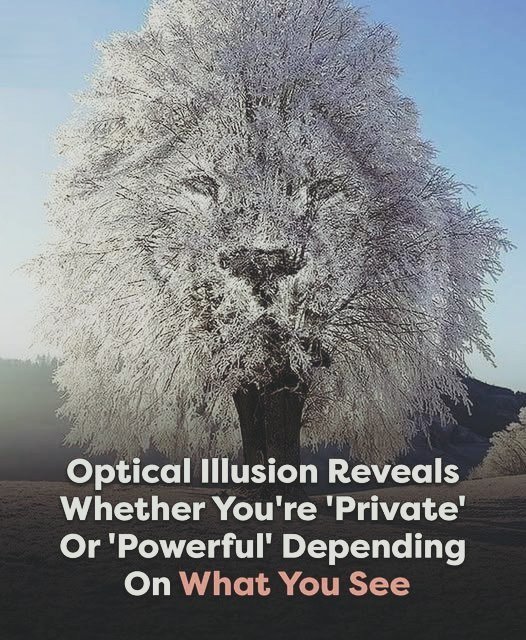
Everyone is noticing something completely different
Beyond science and education, optical illusions also have a philosophical dimension. They quietly challenge the idea that perception equals reality. If two people can look at the same image and see different things, then what does “objective seeing” really mean?
This question extends far beyond visual puzzles. In everyday life, people interpret the same events differently all the time. A conversation, a gesture, a decision—each can be understood in multiple ways depending on perspective. Illusions simply make this process visible in a controlled environment.
The brain’s tendency to “complete” missing information is especially important here. This process, known as perceptual completion, helps us recognize objects quickly. We don’t need to see every detail of a chair or a face to identify it. The brain fills in what is missing based on past experience.
But in illusions, this strength becomes a weakness. When information is deliberately incomplete or contradictory, the brain still tries to force it into something familiar—even if that leads to incorrect or shifting perceptions.
This is why illusions often feel like they “change” when we look at them longer. In reality, the image isn’t changing at all. What changes is our attention. Once we notice a different pattern or reinterpret a shape, the brain reorganizes the visual data accordingly.
Some researchers also study how emotional and cognitive states influence what people see first in an illusion. While popular internet claims often suggest that first impressions of illusions reveal personality traits, science does not support this idea in any reliable way. Instead, initial perception is more closely linked to attention habits, visual sensitivity, and contextual priming.
In other words, what you notice first is not who you are—it is how your brain is currently processing information.
Still, these differences are meaningful. They highlight the diversity of human perception and remind us that no two minds interpret the world in exactly the same way.
Another important concept illustrated by optical illusions is cognitive bias. The brain tends to rely on shortcuts to make fast decisions. These shortcuts are usually helpful, but they can sometimes lead to errors in judgment. Illusions exaggerate these shortcuts, making them easier to observe and understand.
For instance, when the brain expects to see a face, it may interpret vague shapes as facial features even when none exist. This tendency is so strong that humans can recognize faces in clouds, trees, or random patterns. It is an evolutionary advantage—but also a source of illusion.
What makes optical illusions so enduringly popular is that they sit at the intersection of science and experience. You don’t need specialized training to engage with them. You simply look—and then question what you see.
That moment of uncertainty is powerful. It interrupts automatic thinking and encourages curiosity. It reminds us that perception is not always as stable as it feels.
Even in everyday life, this lesson applies. We often believe we are seeing situations clearly, but our interpretation is shaped by context, expectation, and emotion. Just like an illusion, reality can sometimes be more flexible than it appears at first glance
Optical illusions, in this sense, are more than visual tricks. They are tools for reflection. They show us that the mind is not a passive observer, but an active participant in constructing reality.
And perhaps that is their greatest value: they remind us to slow down, look again, and accept that there may always be more than one way to see the world.
