Short link: https://short.pageviewpro.com/Eto8js
3. Ganglion Cysts
Ganglion cysts are fluid-filled lumps that commonly develop near joints or tendons, including those around the fingers and wrists.
They are usually round or oval and may feel firm or rubbery. Their size can change over time, and some disappear without treatment.
Although many ganglion cysts are painless, they may cause discomfort if they press against nearby nerves or interfere with movement.
A healthcare professional can examine the lump to determine whether it is a ganglion cyst or another type of growth.
4. Gout
Gout is a form of inflammatory arthritis caused by the accumulation of uric acid crystals in the joints.
It commonly affects the big toe, but it can also involve the fingers and hands.
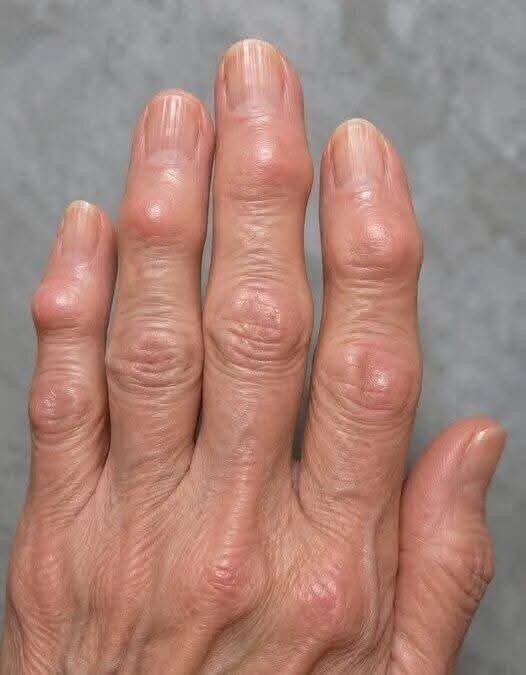
In some people with long-standing gout, firm deposits of uric acid crystals called tophi develop beneath the skin.
These deposits may appear as hard lumps around the joints and can sometimes become painful or affect normal movement.
5. Bone Spurs
Bone spurs are small bony growths that develop along the edges of bones, often in response to joint damage or long-term wear and tear.
When they develop around finger joints, they may appear as hard bumps beneath the skin.
Some bone spurs cause no symptoms, while others may contribute to pain, stiffness, or restricted movement.
When Should You See a Doctor?
Not every lump on a finger joint is dangerous. However, certain symptoms should not be ignored.
Medical evaluation is recommended if a lump:
- Grows quickly or changes in appearance.
- Becomes painful or increasingly swollen.
- Is accompanied by redness or warmth.
- Makes it difficult to bend or straighten a finger.
- Appears alongside persistent joint stiffness.
- Develops with unexplained fever or other symptoms.
Sudden severe pain, redness, and swelling, especially with fever, require prompt medical assessment.
How Are Hard Lumps Diagnosed?